
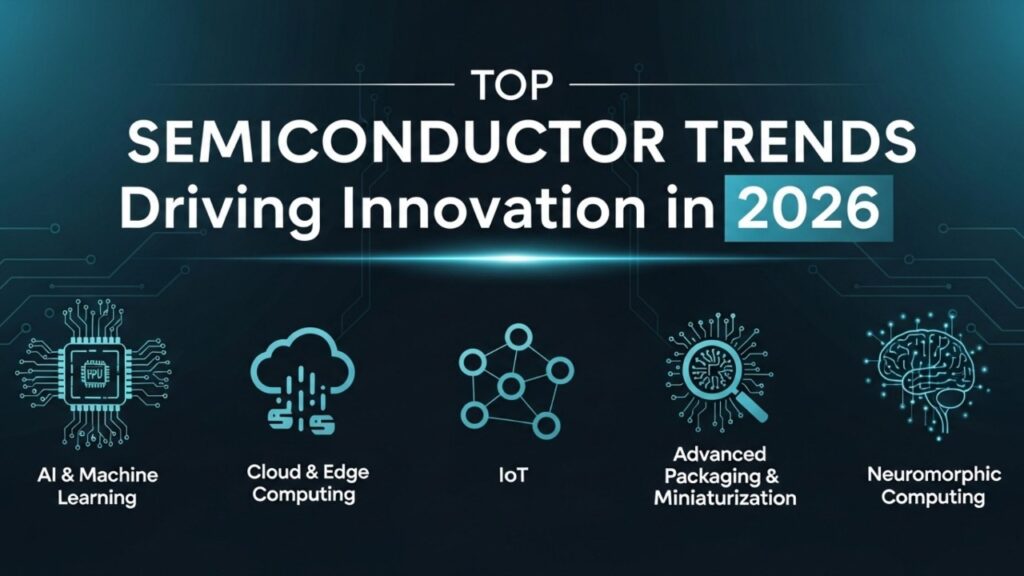
Modern technology relies on the semiconductor industry for everything from smartphones to electric vehicles to artificial intelligence (AI) and cloud computing. Global industries are being reshaped as we move closer to 2026, as the demand for more powerful, smaller, and more efficient chips grows. A large amount of investment is made by companies around the world in research and development in order to stay current with technological advances. Let’s explore the top semiconductor trends driving innovation in 2026 and how semiconductors will transform the digital economy.
1. AI-Powered Chip Designs
Artificial intelligence has become a key driver of semiconductor innovation. Manufacturers of chips are integrating artificial intelligence not only into devices but also into the design process itself by 2026. AI-powered algorithms allow engineers to optimize chip layouts for performance, power efficiency, and scalability. This results in faster delivery times and reduced production costs. A wide range of current applications will be enhanced by AI-optimized chips, ranging from self-driving cars to healthcare diagnostics.
2. The Rise of 3D Chip Stacking
Moore’s Law is slowing as the industry shifts to 3D chip stacking. This method layers chips vertically, allowing more transistors to fit into smaller spaces without traditional scaling. 3D chip stacking will dominate advanced processors for data centers, gaming consoles, and artificial intelligence servers by 2026. Our technology boosts performance, reduces latency, and improves power efficiency, key factors for industries pushing computing boundaries.
3. Sustainable and Green Semiconductors
Sustainability has become a priority due to increasing concerns about climate change. Semiconductor companies are adopting eco-friendly manufacturing processes, reducing water consumption, and minimizing their carbon footprints. Green semiconductors designed for energy-efficient operations will be a core focus by 2026. A more sustainable digital future will rely on these chips for a variety of applications, such as efficient IoT devices and renewable energy systems.
4. Quantum Computing’s Breakthroughs
Quantum computing is still in its early stages, but by 2026, we should expect significant progress in semiconductor technologies that power quantum processors. Statistical bits (qubits) provide unprecedented computing capabilities. Semiconductor companies are experimenting with superconducting materials and advanced lithography to make scalable quantum chips. Our developments could transform industries like pharmaceuticals, cybersecurity, and financial modeling.
5. Semiconductor Supply Chain Resilience
The pandemic highlighted the fragility of the global semiconductor supply chain. The goal is for companies to establish more localized manufacturing hubs by 2026 in order to reduce their dependence on specific regions. Governments also support this trend with policy incentives and funding. A more resilient and diversified supply chain will ensure smoother chip availability, helping industries such as automotive, electronics, and defense avoid disruptions.
6. Automotive and EV Semiconductor Growth
Electric vehicles (EVs) and autonomous cars are transforming the automotive industry, and semiconductors are at the heart of this shift. Adaptive chips will be in high demand by 2026 as a result of advances in battery management, advanced driver-assistance systems (ADAS), and vehicle-to-everything (V2X) communications. Our chips need to be reliable, durable, and highly efficient to meet next-generation transportation demands.
7. Evolution of Advanced Packaging
Once considered secondary to design, semiconductor packaging has become a critical performance factor. Advanced packaging techniques such as chiplets, system-in-package (SiP), and heterogeneous integration are setting new standards. Advanced packaging will enable more compact, powerful devices by 2026, bridging the gap between cutting-edge design and practical applications.
8. Edge Computing and IoT Expansion
As more devices connect to the internet, edge computing chips continue to rise. Our chips process data closer to the source, reducing latency and improving efficiency. Consumer and enterprise semiconductors tailored to IoT sensors, smart homes, and industrial automation will drive innovation by 2026. The trend ensures faster response times and more secure data handling.
9. Global Competition and Collaboration
The semiconductor industry has always been highly competitive, but in 2026, collaboration will also play a large role. Companies will form alliances to collaborate on advanced chips, share R&D costs, and ensure access to critical materials. Global collaboration will accelerate technological breakthroughs while maintaining competitive advantages.
10. Ciliconchip: Shaping the Future
Ciliconchip is playing an increasingly important role in shaping the semiconductor landscape as innovation accelerates. We ensure industries remain competitive by leveraging advanced manufacturing, AI-powered designs, and sustainable practices. Whether it is quantum computing or automotive solutions, Ciliconchip is dedicated to providing solutions that power the future of digital transformation.
Final Thoughts
The semiconductor industry is entering an exciting transformation process. Featuring AI-driven designs, sustainable solutions, 3-D stacking, and improvements in automotive and quantum computing, 2026 promises to bring significant technological advances. Companies that adapt to these trends will lead innovation and gain a competitive edge in the global market.
A clear path leads to success. A semiconductor is more than just a component, it is the foundation of future technology.